Graphene at Industrial Scale: A North American Perspective
Why formulation, supply chains and material consistency will determine which graphene technologies actually scale.
By Matt Prentice, Vice President – North America
As Vice President for North America at Levidian, I spend much of my time speaking with manufacturers across the region - from materials companies and chemical producers to energy and industrial technology firms. A common theme in many of these conversations is graphene.
Across North America, graphene is no longer just a research topic. Manufacturers across sectors - from coatings and polymers to energy storage and advanced materials - are actively asking how the material can improve real products.
Yet despite more than a decade of excitement, graphene has struggled to reach true industrial scale. The reasons are rarely about performance. The material’s strength, conductivity and multifunctional properties are well understood.
The real barriers have been practical.
How is graphene supplied?
How consistent is it?
Can it be produced reliably at industrial scale?
From my perspective working with manufacturers across North America, three issues determine whether graphene moves from the lab into full-scale adoption.
Powders Are the Wrong Starting Point
One of the most overlooked barriers to graphene adoption is the format in which it is delivered.
Many graphene materials are supplied as powders. That might work in a laboratory, but industry cannot wait to figure out how to scale later - it slows adoption. Solutions that require additional processing after delivery do not scale, they stall. Handling fine powders introduces safety risks, inhalation concerns and variability during dosing and dispersion.
Industry does not want powders that need to be “figured out” after they arrive. Manufacturers want materials that integrate directly into existing processes.
This is why engineered dispersions are becoming the more practical route. Instead of shipping powders, graphene can be delivered as a stable liquid dispersion that integrates directly into formulations for coatings, polymers, composites and energy materials.
When graphene arrives ready to use - rather than requiring additional processing - the barrier to adoption drops dramatically.
Rethinking the Supply Chain for Advanced Materials
Another major constraint to large-scale graphene adoption has been the way graphene is produced and supplied.
Most companies currently rely on centralized production, mined feedstocks and long global supply chains. That structure can introduce cost volatility, logistical complexity and geopolitical risk.
A different model is beginning to emerge.
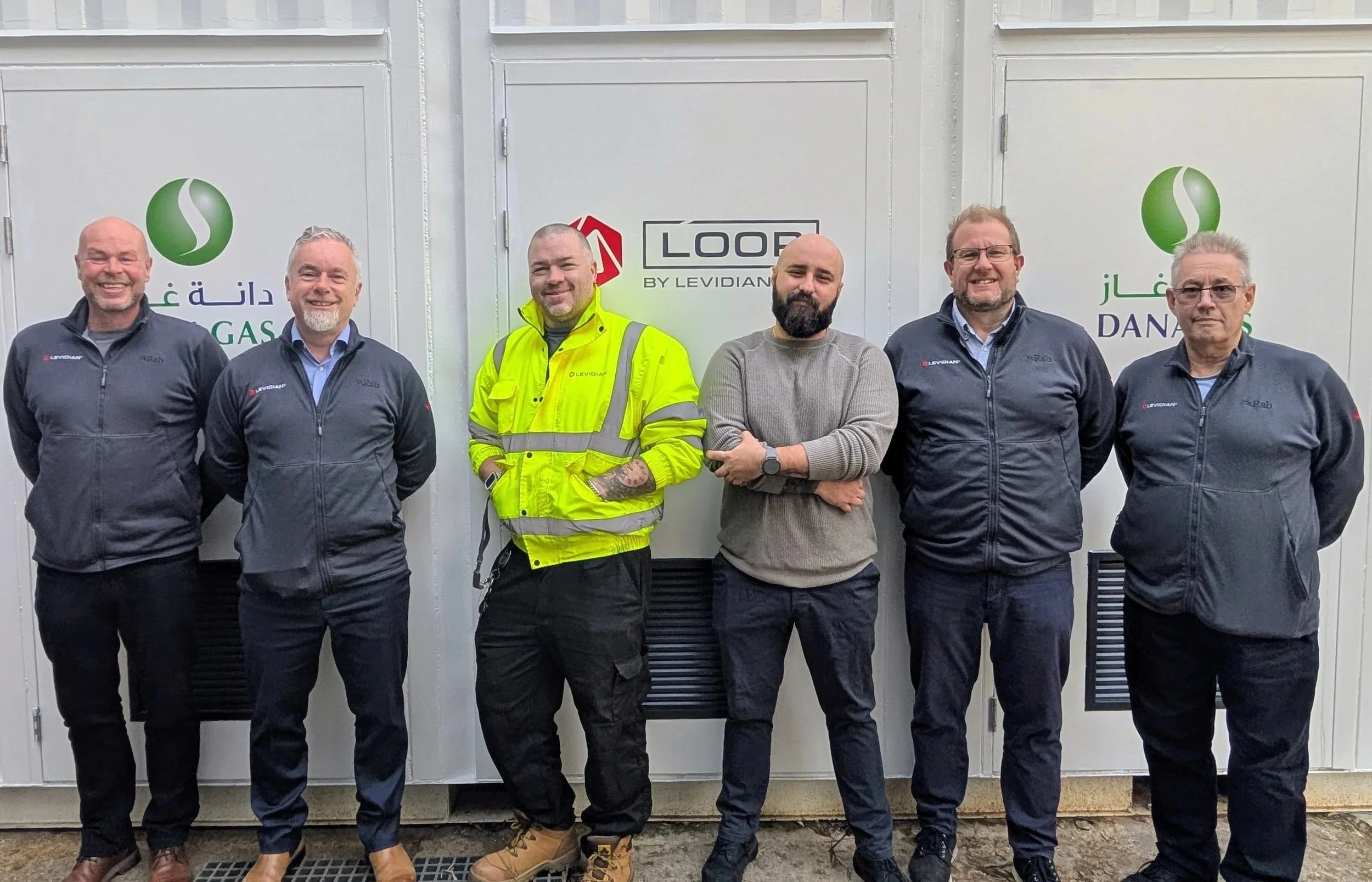
Levidian’s LOOP technology produces graphene directly from methane using a controlled microwave plasma process. The systems are containerised and designed to operate directly at the point of use, enabling localized production of advanced carbon materials rather than relying on mined graphite moving through global supply chains.
This opens the door to distributed production networks where graphene can be produced regionally, closer to manufacturing demand.
In North America, early collaborations are already exploring how this model could support industrial production.
Consistency Will Decide Which Technologies Scale
Ultimately, however, one factor matters more than any other: consistency.
Manufacturers need to have confidence that a material will behave the same way every time it enters a formulation. Variability in graphene structure or purity has historically made this difficult, particularly when materials rely on aggressive mechanical processing, chemical exfoliation, or high-energy production methods that introduce variability.
G3 graphene is produced directly from methane within a controlled microwave plasma environment. Importantly, this is not combustion or pyrolysis. The process does not combust and consume the calorific value of the gas. Carbon is separated prior to end-use, allowing the remaining gas stream to retain its calorific value at a reduced CO₂ potential.
The methane feedstock remains part of the output stream rather than being consumed in the process, reducing both emissions and feedstock cost exposure.
With graphene being formed directly in the plasma phase, the resulting carbon structure is inherently consistent from batch to batch and from site to site.
There is no secondary purification, milling or extensive post-processing required to make the material usable. It emerges from the reactor ready to integrate into industrial formulations.
The current market-ready LOOP system design will produce approximately 10 tonnes of graphene per year within a compact footprint, enabling the same material specification to be produced wherever the system operates.
Consistency, not novelty, will ultimately determine which graphene technologies succeed.
From Research Material to Industrial Platform
Graphene’s potential has been widely discussed for years. What is now changing is the ability to deliver the material in a form that industry can actually use.
Engineered dispersions remove the handling barrier. Distributed production reduces supply chain risk. And consistent material quality enables manufacturers to rely on graphene as a real industrial input.
Across North America, the conversations I am having with manufacturers are increasingly focused on these practical questions.
The next phase of graphene’s development will not be defined by laboratory breakthroughs. It will be defined by how effectively the material integrates into real manufacturing systems.
That transition is now underway.

About the Author
Matt Prentice is Vice President – North America at Levidian. Based in the region, he leads the company’s commercial activities across North America and works closely with manufacturers, energy companies and materials producers exploring how graphene and hydrogen technologies can be integrated into industrial processes.