Graphene at Industrial Scale: A European Perspective
Why standardisation, sustainability and application-led integration will determine which graphene technologies scale.
By Ellie Galanis, Commercial Director
Across Europe, graphene has long been more than a promising material. Since its isolation at the University of Manchester, the region has maintained a leading role in its scientific and industrial development. With over two decades of coordinated investment through initiatives such as the Graphene Flagship, and specialist facilities such as the Graphene Engineering Innovation Centre, Europe has built one of the world’s most advanced ecosystems for graphene research, development and real-world validation.
Today, I can see that the conversation is shifting quite dramatically from R&D and towards industrialisation.
Manufacturers across sectors - from coatings and polymers to automotive, construction and energy - are no longer asking what graphene could do. In many cases, they have already tested it. The focus now is more practical: where does graphene deliver measurable value, and how can it be integrated reliably into existing manufacturing systems?
Despite Europe’s strong research foundation, large-scale commercial adoption has remained uneven - and the real barriers are structural:
How is the material specified and certified?
Can it be produced consistently, compliantly and at scale?
And how easily can it integrate into existing industrial processes?
Regulation and Standardisation as Enablers
A defining characteristic of the European market is its regulatory and standardisation framework.
Under REACH, manufacturers operate within a well-established system for chemical registration, safety and compliance. Rather than acting as a barrier, this framework provides clarity. Materials that are properly characterised, documented and registered can move more confidently through the value chain.
This shifts the focus of graphene adoption - the key question is not simply whether a material can be handled safely, but whether it is consistently specified, traceable and aligned with recognised standards.
Across Europe, increasing emphasis is being placed on:
Material characterisation and classification
Batch-to-batch reproducibility
Independent validation and certification
Consistency, therefore, is not just a manufacturing requirement - it is a regulatory and commercial necessity. Without it, graphene remains difficult to specify in industrial procurement processes.
Reproducibility and Specification Control as the Basis for Scale
Graphene’s path to industrial use is limited less by performance than by reproducibility.
Its properties are highly sensitive to how it is made. Differences in synthesis route can alter layer count, size and morphology, defect density and surface chemistry - variations that may not appear meaningful in basic characterisation but become evident during processing and in final performance.
Materials are therefore judged not just on composition, but on their ability to deliver consistent behaviour under defined conditions. Even small structural variations can shift functional, mechanical or rheological outcomes.
The requirement, therefore, is not simply “quality” but process-controlled reproducibility.
In Europe (where qualification, certification and long-term supply are critical) this places emphasis on tightly controlled synthesis, minimal post-processing and stable, performance-linked specifications.
Plasma-based production offers one route to achieving this. By forming graphene directly under controlled conditions, it reduces the variability associated with multi-step processing and avoids downstream modification steps that introduce inconsistency.
Equally important is replicability. Modular systems operating under identical conditions enable the same material specification to be produced across locations - supporting regional supply models common in Europe.
Reproducibility is therefore both a technical and commercial requirement. Graphene technologies that can deliver stable, transferable specifications are far more likely to move beyond pilot scale.
At industrial scale, predictable performance - not peak performance - determines adoption.
Fit-for-Purpose Formats, Not Just Powders
The way graphene is delivered into a process is not a secondary detail - it directly influences how effectively it can be used.
In Europe, powder-based materials have remained viable, largely because many industries - plastics, coatings and construction in particular - already operate established powder mixing, compounding and masterbatch workflows. Graphene can, in principle, be integrated into these systems without fundamentally changing existing processes.
But this compatibility comes at a cost.
Fine powders are inherently difficult to handle with precision. Small variations in feeding, mixing or dispersion can translate into inconsistent performance at the application level. Additional processing - whether through high shear mixing, functionalisation or intermediate masterbatch steps - introduces both complexity and variability, limiting throughput and slowing scale-up.
The direction of travel is therefore becoming more application-specific.
Rather than converging on a single preferred format, the market is moving toward materials engineered for their end-use environment. Solid forms remain appropriate where existing infrastructure supports them. In contrast, liquid-phase systems - such as coatings or battery slurries - benefit from “drop-in” pre-dispersed solutions that reduce processing steps and improve reproducibility.
The challenge is not choosing between e.g. powders and dispersions, but ensuring that the material arrives in a form that minimises transformation between supply and final use.
Localised Production and the Drive for Decarbonisation
Supply chains for advanced materials are also evolving across Europe, but the drivers differ from those in other regions.
While resilience and localisation are important, they are closely tied to a broader priority: decarbonisation.
European industry is under increasing pressure to reduce emissions, both through regulation (e.g. the Emissions Trading Scheme) and through corporate net-zero commitments. This creates a strong incentive to rethink how materials are produced and sourced.
Technologies that enable local, lower-carbon production of advanced materials are therefore particularly well aligned with European priorities.
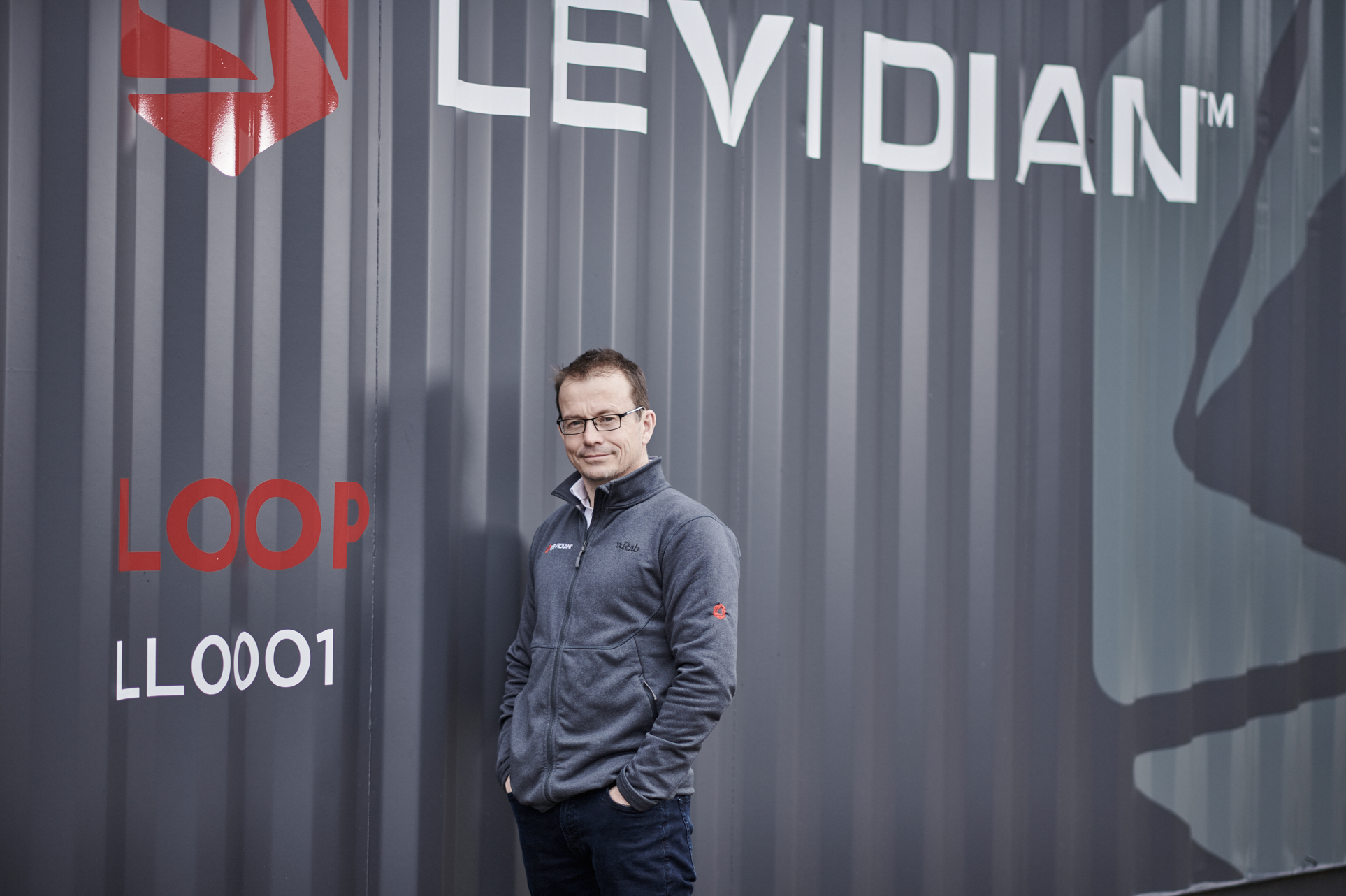
Levidian’s LOOP technology produces graphene directly from methane, a potent greenhouse gas, using a cold microwave plasma process. The system is modular and designed to operate at the point of use, enabling distributed production closer to manufacturing demand.
Importantly, this process does not combust the gas in order to produce the plasma – the microwave energy alone is enough to crack the methane. Carbon (graphene) is then stripped from the methane, leaving a cleaner hydrogen-rich gas, and since hydrogen has a higher energy content than methane the remaining gas stream retains its calorific value while reducing its associated CO₂ potential. Customers can switch their methane-based energy supply for a viable low-CO₂ alternative.
This approach offers two advantages that are especially relevant in Europe:
Reduced reliance on mined graphite and long global supply chains which are typically required to make graphene
Enable a pathway to lower-carbon material production and decarbonised energy supplies aligned with industrial decarbonisation goals
As a result, distributed production is not simply a logistical innovation. It becomes part of a broader shift toward more sustainable and regionally integrated manufacturing systems.
From Research Leadership to Industrial Integration
Europe has led the world in graphene research. The next phase is about translating that leadership into industrial reality.
This transition will not be driven by new material discoveries alone. It will depend on how effectively graphene can be: Specified and standardised
Integrated into existing manufacturing systems
Produced sustainably and at scale
Across Europe, the conversation is no longer about potential. It is about implementation.
Graphene is moving from a research material to a functional industrial input. The pace of that transition will be defined not by what the material can do, but by how seamlessly it fits into the systems that industry already relies on.
That transition is now underway.